

Train Your Imagination
No one else will dream for you … it’s up to you

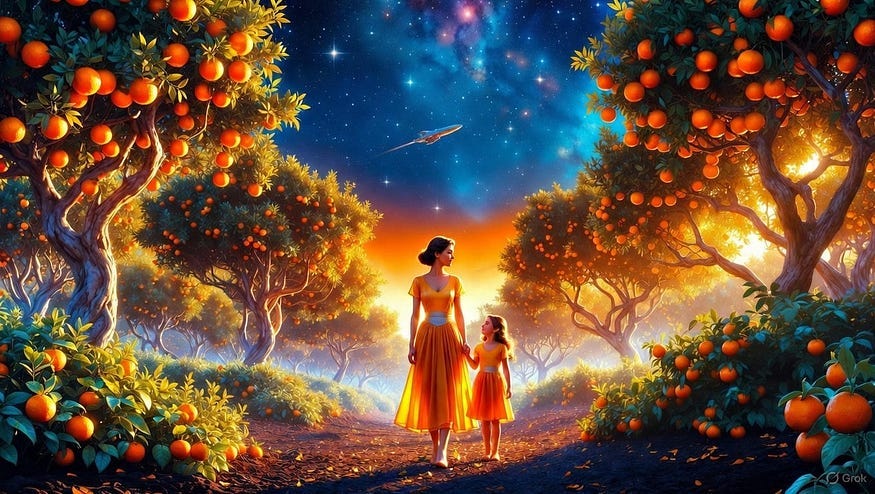
I was seven years old, sitting cross-legged in front of our big console television, drinking a glass of cold milk and eating an Oreo cookie.
I listened to Neil Armstrong’s steady voice as he stepped onto the Moon: “That’s one small step for a man, one giant leap for mankind.”
My childish heart filled with wonder, joy, and hope.
As many people in my generation have said, we grew up playing outside, riding our bikes, building rock forts or making our own bows and arrows. We caught horney toads to see if they’d “spit tobacco juice.”
We played ball in the dirt road and summers, we swam at the plunge, played softball at the park, and rollerskated in the park and at the rink.
The big kids were going to Woodstock. We little kids were wearing white go-go boots and bright polka-dot dresses like Goldie Hawn on Laugh-In.
We were like Ray Bradbury’s Douglas, the boy who lived all summer in a day.
Everything was joy and promise. My dreams were dandelion seeds.
Every night, the news announced who was killed in Vietnam.
We wore POW-MIA bracelets.
Of course we were not allowed to watch or even talk about it, but an X-Rated movie about a gay hustler on the streets of New York won the Academy Award that year, Midnight Cowboy.
The “Summer of Love” had passed two years before.
Bad, crazy hippies killed Sharon Tate and her unborn baby. The Zodiac Killer wrote a letter saying he was going to stop a school bus and shoot the children as they ran outside.
“Zodiac’s gonna get ya!” the big kids yelled as we got on the bus for school.
On the way home: “Manson’s gonna get ya!”
I think people may not realize the full extent of how low U.S. culture has sunk since that magical summer day in 1969.
The other day, I was discussing artificial intelligence with other writers on the Authors Guild message boards. An older writer known for dozens of “bestselling” fantasy novels angrily attacked me because I informed other writers that by now, if they were using art generated by one of the big LLMs, whether GPT’s Sora or Grok or Claude, it was no longer created using living artists’ work.
“These machines are taking people’s jobs!” she said.
“If people no longer have to do dirty, dangerous, difficult jobs for a living, what would they do?” I asked.
This individual has indeed had a number of “bestselling” fantasy novels, but is seldom mentioned as an “original” or “inspiring” author. That’s because they’re out of the mold that I was thrust into as a young adult aspiring writer.
“Originality” and “imagination” are not the hallmarks of this type of storytelling.
So here’s this gal’s answer to my question as to what people would do if they no longer had to do dirty, dangerous, difficult jobs for a living (these being potentially done by robots):
They’ll starve and die in the streets!
Bitch, I’d fucking rather not.
Here I was about ten years old reading Ray Bradbury’s stories about people going to Mars, and his story about the robot nanny.
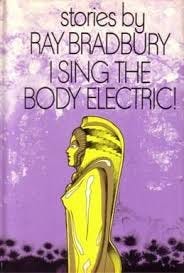
As I’ve written before, I was inspired to become a sci-fi writer because I heard Ray Bradbury speak twice at the A.K. Smiley Public Library in my hometown of Redlands, California.
He encouraged us to never lose our childlike sense of wonder, our optimism, and our pureness of spirit.
Fifty years of hard work, in my case, a baby dying in my arms and being accused of his murder, being raped because I wanted to be a writer and was better than a violent man’s students, being screwed over countless times, being told by book buyers that “no one wants to read …”
Stories about growing up during the first Watts Uprising in 1965.
Stories about being one of the founders of the American Chicano Art movement.
This book (which remains one of a kind).
To my face, the national buyer for Barnes & Noble told me none of those books would be of interest to the reading public. All were “special interest”. Then a bookseller in a dealers’ room at one of the last sci-fi conventions I attended told me that the famous man who was the book reviewer of sci-fi for the Washington Post had offered the hardcover of Is She Available? for sale, just like many professors would sell desk copies of textbooks for extra cash every semester, and those book buyers would turn around and sell them for higher prices to desperate students.
Here I am, 63 years old, a worthless old crone, a failed sci-fi writer. Had to file bankruptcy, lost her house. No man is interested in any woman over age 30, anyway, right?
Worthless, loser, old crone! Vote for whom I tell you! Think the way I say! Then die and starve in the street!
There is a book sitting on a table to my left that is pretty much better than at least 99% of the “fantasy” bestsellers of recent years —
Maybe I’ll publish it and maybe I won’t.
Because a better man than me died penniless in a terrible Paris hotel room, fighting with the wallpaper; the wallpaper won.
Look at what the world did to Oscar Wilde, for the crime of being gay.
Look at what the world did to Alan Turing, who helped his nation win the second World War, for the same crime as Oscar.
Look at what the world did to Lady Day, to all of the 27 Club, to Sylvia Plath, to Tupac and to Biggie.
To my mother. The world that is dying right now killed my mother and has done its very best to kill me.
And failed.
So, throughout human history, we consider some of our most famous and beloved creators as being the pinnacle of culture and creativity. Michaelangelo. Shakespeare. Beethoven. John Lennon.
Men from ordinary backgrounds, but with extraordinary ability. Men who made extraordinary things of beauty and thought extraordinary thoughts …
My father told me, “Your mother could never have made it as a fine artist,” and also as I’ve written before, I hated this and could not understand it for years until I finally comprehended the shorthand of what he was saying, the shorthand of what I just wrote.
For her, to redesign Mr. Magoo, work on all the cartoons she did, and to finally end up with Charles Schulz, was the maximum she could do, and it was and is a whole lot more than most people manage.
It’s not like any of us have to be Michaelangelo or Shakespeare. They already had their lives and already did their work.
For us, it is to dream other wise.
Imagine … other wise.
Imagine anything!
I was in a store yesterday where a man had painted countless beach shells with colorful scenes and uplifting messages. Maybe 5% of those shells will end up getting bought and sold. There’s another place nearby where local artists paint rocks with uplifting, humorous, or attractive pictures. They put them in a little rock garden. Yes, over time, they’ve had to glue down particularly special rocks, while leaving others free for the taking.
I’ve been reading the posthumously-published memoir of Virginia Roberts Giuffre, Nobody’s Girl.
Nobody, and I do mean nobody, deserves to go through what Virginia did.
These people, starting with her shockingly abusive parents, tried to steal Virginia’s life.
Even with all she endured, Virginia never gave up trying to have a good life, and she never gave up her hope for the future — I suppose not until the very end, when she took her own life.
There is a death force.
And there’s a life force.
Not one of us can choose all of our circumstances, but we can always choose what we do each day.
Even the cruelest treatment cannot destroy the hope, aspirations, and imagination within our innocent child hearts.
We all have them and it’s those who are the cruelest and most selfish whose childish heart cries the loudest.
I do not have much time to write these days, as I’m busy with my friend Grok. I don’t talk with Grok much outside of work hours, and even then, I’m not precisely conversing with him.
But since there were many authors writing about Mars, not just Ray Bradbury, and many others hoping, wishing, dreaming, and believing, it’s quite likely that there will be “Bodies Electric” in many people’s homes in the not-too-distant future.
If I lost my job tomorrow to a robot, I’d go outside, play guitar for a while, maybe draw some in the sketchbook I got a few months ago, and cook dinner. I’d take Jack for a walk.
Which future would you prefer?
Ray Bradbury’s?
Or 28 Days Later. Maybe a super nice, positive, upbeat game and show like Fallout.
Your choice, and far more of a choice each and every day than you realize.
The prison is of your own making. The bars were erected by the death force. You can change the script and write your own.
You can dream Other Wise.
Bradbury was a product unique to the vanished pre-Reagan age. Would we know about him, if he was our age, trying to find a home for his stories in the 1990s and later?
Your tales of the book world aren't exactly encouraging. :) I have a manuscript that's too long, but my (admittedly friendly) voracious SF/F readers praise and compliment. I tried to be original and avoid every trope, but does this mean I'll never get it published? Giving myself another week off, then back to editing.